
Vision
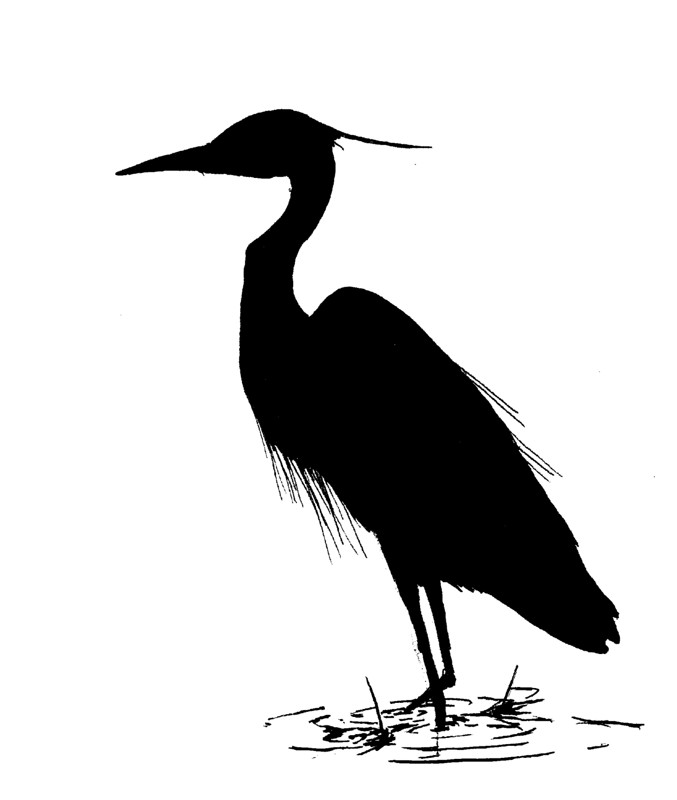
The great blue heron is the only known animal to possess “zoom lens” eyes. They have specialized retina architecture that includes two fovea (depression where light from the lens is focused on the retina) in each eye, and unusually strong cilia muscles to alter the shape of the lens. Using these muscles and retinal features, they can switch from macroscopic scanning to telescopic focus for a strike in an instant. With vision many times better than human eyesight, they are highly successful hunters—about 80% success rate per attempt. They also have excellent night vision, allowing them to fly and hunt at night, just as comfortably as by day. Heron teaches us how to be effective spiritual healers. To become effective spiritual healers, we must gain the ability to see both macroscopically and telescopically, both in the day and at night.
Heron is not the only teacher. Every plant and animal has a lesson, possesses wisdom. Just as a healthy ecosystem has all manner of plants and animals, each fulfilling a role, so human society needs people of all kinds. The bear, the fish, the mink, the chipmunk, the sparrow—all have a teaching, all have a song. Each of us will resonate differently with these many notes in life’s symphony, with these many songs in the Song of Songs. We each have a niche in the family of life and a song to sing.
Heron, to me, is the embodiment of the Taoist sage as described by Lao Tsu and Zhuangzi. Rather than working against the flow to achieve goals, Heron puts her confidence into the river of life, that it will bring what is needed in its season. She is successful in her endeavors because she is receptive, still, passive. Heron embodies wu-wei—action without self-effort.
Heron also embodies the Taoist wisdom of embracing opposites as compliments, rather than as opposing sides to choose from, one good, one bad. Darkness is not worse than light because without darkness, the meaning of light is erased. Cold is not inferior to heat, because without coldness, heat destroys. What is above is not superior to what is below because the two only have meaning and location because of the other. They are in fact two parts of one truth.
Herons have excellent day vision—four times greater than ours, and also excellent night vision. They are comfortable flying and fishing in the dark. An effective healer can also see in the dark, meaning, they have come to recognize that just as both day and night are necessary for life to flourish, confusing, dark and unhappy states are just as important for the journey of life as the happier and clearer states. Great blue herons are equally comfortable observing from a very high perspective and wading in the water of life.
Just as Heron can adjust her eyes to see in different ways, human beings enjoy several sets of eyes. Each has its own role. When properly organized, they work in concert and produce good. When the higher eyes are shut, the lower eyes misperceive.
The first set are the physical eyes. They are there to serve us in navigating the physical world and to enjoy all the visual there.
Going deeper, we have the eyes of memory, which allow us to see and explore the store of knowledge and events that otherwise lie dormant within us.
The next set of eyes is logic, which furnishes us with the ability to see order, patterns, mechanisms, and laws by which things both physical and abstract operate.
We also have the eyes of imagination, which allow us to see non-logical and non-linear relationships between things, envision possibilities, and sometimes see ideas and dreams that seem to arrive from somewhere beyond our own mind.
Borrowing some aspects of logic, and some of imagination, we have symbol eyes, which enable us to see deep truths hidden within the mundane. They see the world in terms of parable, allegory and symbol. Myths, religious iconography, and ritual come into view when viewed through these eyes. Nature also comes to hold deep meaning when seen through these eyes. A tree is no longer just a tree, no longer lumber for profit, no longer mere biomechanics arising from evolution, no longer even only a precious place holder in the web of life. The tree is a great teacher of spiritual truth.
Finally, we have the eyes of the heart—empathy, the most penetrating and true eyes we have. By empathy, we see the soul, the essential state of others, human and non-human alike. The eyes of love see others from the inside out and so gain profound understanding and ability to benefit and heal. Empathy goes beyond seeing spiritual and psychological wisdom in Nature through symbolic interpretation. Empathy sees the soul of things.
What motive and mindset we bring determines which eyes we are using. When we are stuck in egoic fears and goals, our higher sets of eyes are closed. We only see the surface of reality. When we are lifted higher, above ego for ego focus, our vision expands to see a secret world far richer than what we thought we saw.
What if the universe is alive? When we gaze at the stary night sky, what if what greets our eyes is not just the downstream stuff of some original grand explosion, but the growing, developing body of a living being? If this seems radical, it is only because the big-bang, mechanical universe paradigm is so dominant and pervasive. A little consideration shows that the living being model resolves some persistent mysteries of physics. Why is the universe so perfectly balanced on every axis? Why did order arise out of the chaos of an original explosion? Why does the orderliness of the universe keep increasing with time? Why does each step in orderliness include an assembly of parts that lead to something fundamentally more useful than the parts on their own? Why is there evolution? Why do all the parts of the universe and the earth work in such splendid harmony? If the universe is an organism, all of this makes perfect sense.
Physics and chemistry are wonderful descriptions of the mechanics of the universe, but they map out only the most external surface of something that is organized by a purpose of a higher order. The human body has mechanisms by which it operates, but a human being is much more than chemistry. Why not the universe, with its own versions of systems, organs and cells? This seems entirely plausible to me, even likely. An organelle within a skin cell on my knee probably has little or no awareness of me as a living, conscious entity. Likewise, we human beings, as the tiniest of micro-subsystems within the universe, would likely not readily know the universe as a living being. It strikes me as incredibly far-fetched or naïve to think the universe, growing in size, complexity, orderliness, beauty, livingness and consciousness is just happenstance. It makes much more sense that these attributes arise because the universe is an organism. Life is the fundamental driving force within all reality.
A premise inherent in a physical, or physics-only vision of the universe is that it has no inherent meaning or purpose. The idea that the universe is alive suggests that the universe, its structures, its order, its ever-evolving nature and its beauty all have a cause and a reason—life. And the purpose of life seems to be to house consciousness. Consciousness is completely superfluous to functionality, yet life is moving ever towards deeper forms of consciousness. Life and awareness go hand in hand. Lower orders of life have less awareness, and increasingly complex organisms have increasingly higher levels of consciousness.
This leads to an even more intriguing thought, which is that perhaps the natural universe is nothing more and nothing less than the architecture of consciousness. What if the universe houses a consciousness much the way our body houses the consciousness which we experience as me? What if each stratum of more or less self-contained mechanical systems houses a certain type of consciousness, each with its own sense of scale and rhythm, space and time. Each cell in your body has its own version of consciousness, each organ its own, each ecosystem its own, each planet, each solar system, galaxy, the universe as a whole, and even each atom has its own version of consciousness specific to the unique assembly of parts, functioning and interactions. Each of these different strata of consciousnesses are so radically different that they don’t easily communicate or recognize one another as such, but all are embedded within, and are a part of a singular universal consciousness. In other words, the consciousness of the atoms within you cannot be recognized by your own due to the fact that they are operating in a completely different sense of scale, time and purpose, yet collectively their consciousness supports the consciousness of molecules, and they in turn of cells, and they in turn of organs and systems, and they in turn your own consciousness, and you in turn, that of the ecosystems in which you are embedded, and each ecosystem in turn the consciousness of Earth, and Earth’s consciousness in turn a part of the consciousness of the solar system, and so on until one arrives at the universal singular consciousness, which is fractal in structure, yet whole and self-contained.
We have been trained to think analytically and groomed to live materialistically. It is analytical thought that has delivered us the physics and materialism paradigm. What if such thought is limiting? What if looking at reality according to math equations and verbal descriptions is not the best lens for seeing reality? If we exist as biological conscious beings embedded within a fractaline universal biology of consciousness, perhaps gratitude and empathic partnering deliver us closer to the truth. I believe we are using our consciousness in perhaps the least effective way possible. If we are indeed subsystems within a singular universal, fractaline consciousness, then love, goodwill, gratitude and empathy are a much superior way to connect, learn and know. How do we develop a good relationship with a friend, and so find out who they really are?—through love and empathy. These same senses of the heart, when compared to materialism and physicalism, without doubt cause us to become better human beings, yield better cultures, and create better goals. A tree is known by her fruit. A worldview is known by its outcome. This book offers a vision of reality that is new to our current culture, dominated by materialism, Abrahamic religions, and scientific physicalism. Yet the worldview presented does not contradict Abrahamic religions or scientific truth, rather it modifies both.


Leave a comment