Preparing the Way
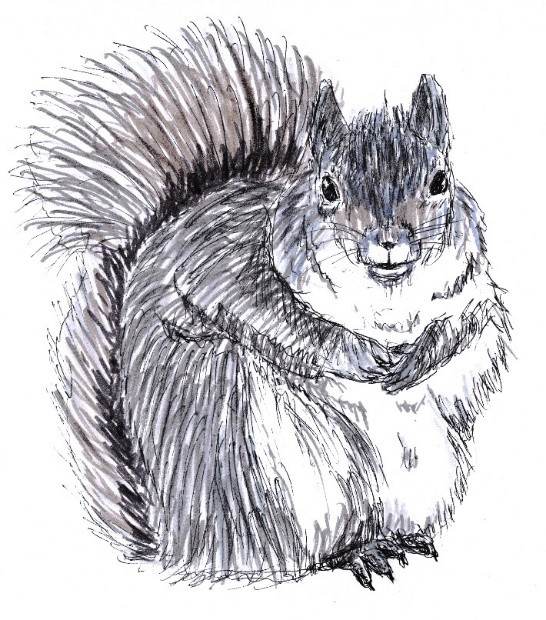
After the better part of that first year, of trying to awaken to the voice of the forest, before I encountered Heron as my teacher, the first breakthrough occurred. I was walking a path along a post and rail fence, demarking forest from field. Lost in thoughts about financial concerns, I didn’t initially notice that squirrels, now behind me, were chattering loudly and insistently, as if to catch my attention. I turned and laughing at the absurdity of my response, asked: “What?” Immediately, my mind was flooded with a message that was in complete opposition to where my mind had been: Do not be avaricious. Do not worry about money. Do not focus on money. The message was clear and I did not feel as if I generated the thought with my own mind. It landed in my heart as a knowing, but quickly enrobed itself in words.
The message to avoid avarice was at odds with what I thought I knew about a squirrel’s likely spiritual message. My conception of squirrels was that they themselves were avaricious, squirreling away food and always on the hunt for more. Returning home, questioning the strange occurrence, I researched what squirrels symbolized to the Lenape, the original people of the land I walked. Fascinatingly, I learned that the Lenape have a legend in which a gigantic squirrel wreaks havoc on the people and the forest with its insatiable greed. To solve the problem, the Creator made the squirrel very small, after which it no longer disrupted balance.
The message of the legend is clear: Avoid avarice. I also learned that squirrels leave 75% of the nuts they bury. Some scientists suggest that the squirrels forget where they buried the nuts. I prefer to think that they are stewards of the forest, helping to plant trees each new year—the opposite of avarice.
In retrospect, I see that this message has to be the foundational groundwork for awakening. Focusing on wealth and seeking it are at odds with hearing the songs and teachings of Nature. When money is the god, all else, including the wellbeing of Nature, becomes less important and will be sacrificed on the altar of wealth.
More fundamentally, the way the mind operates when focused on wealth is incompatible with hearing the spirit of things. It is like trying to open an audio file while running an incompatible operating system. It is like trying to hike up a mountain while insisting on carrying a safe full of gold. Or it is like trying to see a sunrise without being willing to leave the basement. It can’t be done.
Perhaps five minutes after this encounter with the squirrel, I saw a dove above in a low hanging branch. I paused and focused on hearing her message. Though it did not pour into my mind in the same way, I did sense a message: Avoid sensualism—gluttony and lust. It was not a warning against enjoying food and sexuality, but a caution against letting those things take primacy over higher values, like respect, empathy, balance. Again, in retrospect, it only makes sense. These first messages were about preparing the ground. Before I could hear, I had to clear my life of all those things that inhibit receptivity. The dove flew away, showing the path forward. Retreat to higher things.
The third in the series, all the same day, was darker and stranger. I was in a quiet, secluded, and more shadowy part of the forest. felt a presence. It did not offer a warning, but an enticement: Power. I was being given a choice—I could either give myself over to the pursuit of dominance and control, or I could let go of those instinctive goals, and instead trust the flow of life. I could either make my own ego the ruler of my life, or I could become receptive and at peace with a way that is higher than the self. The presence I felt, I now believe, was an externalized awareness of my own ego—everything of me that focuses and serves me over and above anything else.
The term “monkey king” arrived with the feeling of this presence. Arriving home, I did a search for “monkey king” on the internet. There is a Chinese legend of a monkey who defies the gods and causes cataclysmic damage to the order and balance of things. It checked out. That is what the ego in service of the ego does. That is the heart of darkness. It is not an easy thing to relinquish.
Desire for status, power, voice, hurt feelings. I am all too familiar with all of these and many other forms of ego serving ego. I can say, though, that to the extent I am in a state above the ego, to that extent I am awake and able to hear the voices of Nature; to the extent I am immersed in egoic concerns, I cannot.
The ego, the sense of self, is not bad. In fact, it is the most wondrous gift we are given. Only because of a sense of self can we participate in love. Love is something that is shared. Without a self to share, there can be no love. Ego is not bad, but it must be tamed and put into service, not of itself, but the betterment of all, the balance and wellbeing of all. That is its rightful purpose. In becoming servant to the good of all, it finds its kingdom. In seeking to be king, it drags all into hell.
Stillness
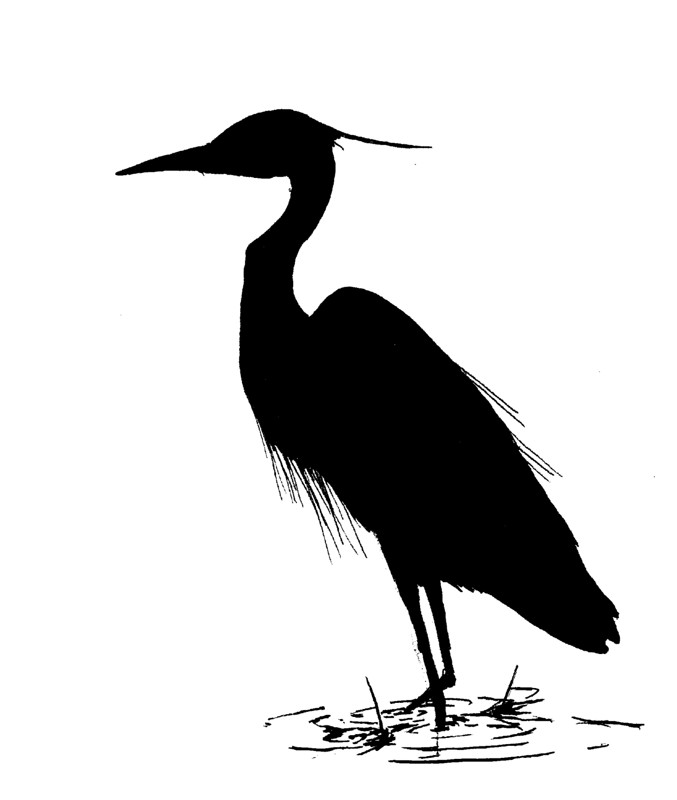
Having watched Heron bask and then wade into the water, I eagerly anticipated the moment he would strike and triumphantly lift a fish up out of the water. I waited. He stood still. I waited some more and he still stood still. I began to feel bored and wanted to move on, but because I felt called to be a student, I waited some more. He did nothing. Eventually, thanking my teacher, I left.
Arriving at the same spot the next day, I was delighted to find my teacher, already in the water. I was excited to see what today’s lesson would be. I waited and watched. Heron stood there, looking into the water. He took a few steps. He sees one! I thought, He’s going to catch a fish!
He stopped and stood. He kept standing. He kept watching the water. I kept watching him. And as before, I grew bored and after thanking my teacher, eventually left. I came back again a few days later when I had a chance. He was not there, so I extended my walk and was happy that a bit further downstream, encountered Heron yet again. He was still standing, watching, and generally doing a lot of nothing. As before, I eventually left. My offering of thanks was less heartfelt. This is getting boring and pointless, I thought somewhere inside. I again heard the message, though, “Come back.”
Though I came back, Heron did not. Nor was Heron there the next time I returned. I began to doubt that I was assigned to be a student of Heron. I knew how crazy that sounded. One evening, I was contemplating these recent events, and as I stepped out into my backyard, I thought to myself: I am probably deluded. Heron probably is not my spiritual teacher. Just then, not two seconds later, a great blue heron flew low overhead. I have never before or since seen a heron flying across my small backyard in my dense neighborhood. I smiled and I believed.
Something very similar happened at another time. Walking along a wooded path that traced a high ridge, I stopped to look out over the creek. So strange all of these experiences were, I repeatedly questioned them. Do I really have a spiritual bond with the great blue heron, or any of nature? Am I am just imagining things? At that very moment, a wind began to flow from across the valley. It grew stronger and stronger, but was very steady. Late autumn leaves let go and tumbled down. Looking up, I saw a lone great blue heron high overhead. It traced a wide circle before gliding out of view. When a need arises, the river of life provides.
The first such encouraging encounter occurred before the first meeting by the creek. My wife and I were walking at night. Something silent slipped mysteriously across the silvery full moon. I felt astonished. It wasn’t an owl. It wasn’t a plane. I thought it might be some strange drone, but it had no lights and I heard no sound. Then it flapped its wings and I at least knew it was some kind of bird. What kind of bird flies at night besides an owl? I wondered.
The next day, at the church’s weekly men’s breakfast, I talked about the strange night traveler, and one of the men knew exactly what it was—a great blue heron; “They sometimes fly at night,” he said. I say this was a confirmation before I actually felt bonded to the Heron because of the way I felt in seeing it glide overhead that night—awe. The magnitude of my reaction, even at the time, surprised me. It was not long later that GB Heron appeared at the creek when I wondered about my animal guide.
So now I believed, but that didn’t make me a good student. In not appearing, I began to get irritable, and eventually, actually angry. I found my mind filled with thoughts such as: Fine teacher you are! Don’t show up for class! The emotion accumulated until the thoughts were loud enough and aggressive enough that I realized how silly I was being, and how impatient despite the lesson of wading in the waters of life with non-attachment. I offered up an apology in my heart and laughing at myself, let go of the negativity.
I finally learned the next lesson, to wait, to have patience, to be still, because when I came back the next day, Heron was back, and every time I returned, Heron was there. He still wasn’t doing anything more than basking, wading, and waiting, but rather than feeling impatient, I now enjoy these times of communion.
I often came with my good, patient, and aging dog, Jada, but Heron seemed to care not at all. We’d come down to the creek bank and Heron would just stand and wade, not more than 30 yards away. Jada knew to be calm and quiet and remained by my side (she was a more ready student than me). She would sometimes wade into the water and lie in the shallows to cool off, even then Heron was unperturbed. At one point, Jada grew so old that after having walked into the forest, I had to carry her out much of the way. It turned out she had bone cancer. She didn’t last much longer. I am glad she was a part of these experiences with me.
So in these ways my teacher taught me to wait, to be patient, and to watch—just as he does when in the water. My nature is to strive, to set goals, and do whatever is required to achieve them. Because it is one thing to learn intellectually by observing, and a much deeper thing to learn into living by experiences that require the lesson, and because this lesson—patience—does not come naturally to me, my teacher knew he had to teach me by a deeper method than example.
The Teaching
Scratch about and the waters grow muddy,
Chase after the fish, it darts away.
The lower mind has its small plan and stirs things up to make it happen.
All that happens is that the true food of the soul is harder to see and farther away.
The higher mind rests in the great flow of life
Neither striving nor fearing,
Ever trusting the provision of the Great and Holy Spirit.
The higher mind knows that when it is right,
The great river of life will provide what is needed.
The higher mind knows that when the fish is in sight,
Hunger will not betray, but will strike,
And the family will be fed.
________________________
The stiller Heron remains, the clearer the water becomes to see the fish, and the more likely are the fish to swim near and provide for Heron.
Taoism focuses on this concept and encapsulates it with the term wu-wei—effortless work. Taoist sage is one who comes to see that the perspective of the self is so limited, that what it believes is true may in fact not be true, and what it believes is good, may in fact be bad. The sage abandons reliance on the perspectives and ambitions of the self, and instead learns to trust in the Toa, the great unseen flow from which all things arise and to which all things return. The Toa leads all things and provides for all things, similar to the idea of the Great Spirit in Native American traditions and the Holy Spirit in Christianity. The primary name for God in Judaism and Christian traditions is YHWH, meaning I Am That I Am—Isness Itself, we might say.
There is a great, unseen force that gives rise to all that is, sustains all that is, guides all that is, and embraces all that is. It gives rise to order and beauty and the animating life within each thing is of this spiritual force, expressed according to the recipient form. The Taoist sage, Zhuangzi, illustrates this as a great wind that blows through a valley. Every object in the valley—bamboo, divots in the rocks, alcoves in the cliffs, and hollows in the trees—sing forth in a unique song according to the shape of each, but the breath of the song is shared and is one—the wind.
The sage learns to trust this universal Spirit over and above the planning and ambitions of the ego. The sage releases the expectations and demands of the self in favor of resting gently with trust in the Tao, the Great and Holy Spirit. In so doing, the sage does without doing, a poetic way of saying that they do exactly what needs to be done for the greatest benefit to all, without having to plan and implement a great deal of difficult effort. The Tao shows them what to do in the moment, and what to say at the right time to say it. This perceptive responsiveness to the need of each moment can only occur when the lower self isn’t muddying up the waters with cares, demands, selfish ambitions, and concerns.
The Great Blue Heron is a beautiful symbolic example of the Taoist sage. Unlike a Buddhist or Christian monastic who works to disengage or transcend the natural world, the Taoist sage is fully engaged and present in day to day living. Heron is in the water, with the water, and looking intently into the water. Heron accomplishes what he or she needs to accomplish to provide for their family without planning, scheming, fretting, chasing about or putting in a lot of work and effort. Instead, Heron trusts in the flow of the river.
Heron also trusts in herself or himself. They know that when a fish arrives, their hunger and instinct will kick in and do what needs to be done to catch the fish. Sometimes we might trust in God, but we don’t trust in ourselves—we don’t trust that we’ll know when opportunity knocks, or that we’ll have what it takes to respond, or we’ll be willing to respond. But if we are hungry for goodness—to be a blessing to this world, we don’t need to worry about any of that. On the other hand, we may trust in our ego but not in God. We feel that we can rely on our plans and instincts, but not on the flow of life and the whisper of Spirit. The only thing we need to do is not follow the urges of the lower self to chase about after fruitless endeavors and in so doing muddy up the waters of mind so that we actually do miss the opportunities to do something great for another person, or for Mother Earth or Heavenly Father (even something simple in service of goodness is something great).
This is wu-wei. We trust with patience, wait and watch, and in so trusting with passivity, great things will get done through us in the benefit of others, human and non-human alike.


Leave a comment